By: Anastassiya Lipovka, Almaty Management University; Zoltan Buzady, Corvinus University of Budapest; and Kuanysh Abeshev, Almaty Management University
In: Problems and Perspectives in Management
Full text via DOI here:
http://dx.doi.org/10.21511/ppm.23(4).2025.34
Abstract:
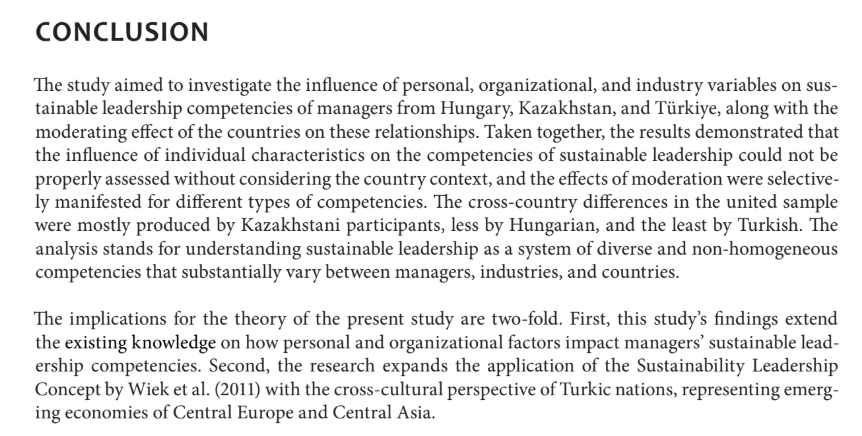
Sustainable leadership has become one of the widely addressed topics over the last decade, both in business and academia. This paper examines how personal, organizational, and industry characteristics influence sustainable leadership competencies across Turkic nations and how the country variable moderates these relationships. The study utilized the results of a comprehensive leadership assessment based on managers’ involvement in a business simulation operated by artificial intelligence and rooted in scientific management. Assessment results of 1,756 managers from Hungary (N = 695), Kazakhstan (N = 647), and Türkiye (N = 414), employed in manufacturing and construction, education and research, finance, production and trade, information technologies, public relations and services, were analyzed. The two-step approach to structural equation modeling was implemented using Python software. The results showed that strategic and normative competences were partially dependent on managers’ gender (β = 1.450, p = 0.022), age (β = 5.678, p < 0.001; β = –3.587, p < 0.001), tenure (β = 3.767, p < 0.001; β = –1.898; p = 0.020) and industry (β = 1.194, p = 0.031; β = 3.092, p = 0.001), whereas interpersonal and anticipatory competencies remained unaffected. The country demonstrated a significant positive moderation in the relationships associated with normative competence (β = 3.260, p = 0.039) and interpersonal competence (β = 5.667, p = 0.041). In contrast, it exhibits a noteworthy negative moderation in strategic competence (β = –3.665, p = 0.043) and systems thinking competence (β = –3.853, p = 0.006). The moderation effect between the managers’ age, tenure, industry, and sustainable competencies was most pronounced in Kazakhstan, followed by Hungary, and least in Türkiye. This nuanced understanding highlights the diverse impact the country has on different aspects of competence, underscoring the importance of context in these relationships.

Keywords:
Sustainable Leadership, Leadership Style, Comparative Study, Hungary, Kazakhstan, Türkiye, OTS, Organization of Turkic States, Gender, Tenure, Age, Sustainability, Turkic Nations, Cross-cultural, stakeholder management, empowerment, future orientation, FLIGBY