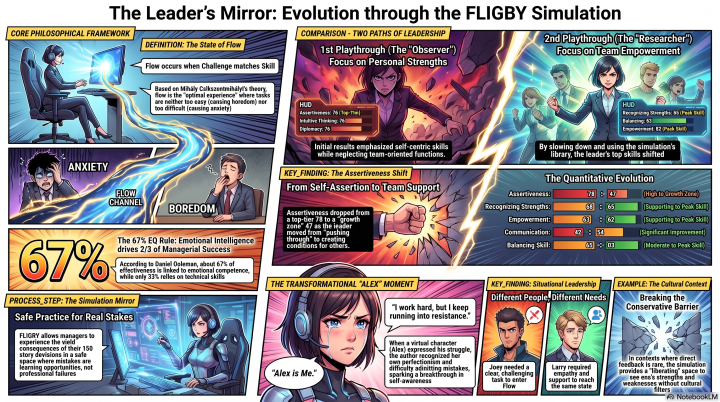
A reflective and analytical account of experiencing the FLIGBY management simulation in the context of developing managerial competencies and emotional intelligence.
Am I really capable of leading people—or was I simply trusted with responsibility?
I asked myself this question not in a lecture hall and not over a textbook, but in the middle of a management simulation, where the fate of a virtual team depended on every decision I made. In recent years, life has repeatedly placed me in leadership positions. For three years, I chaired the student council of a residence hall where almost 480 young women lived under one roof. During initial training in the internal affairs agencies, I commanded a women’s platoon. Today I work as an inspector in the transport police department while studying for a master’s degree in “Management and Leadership in Education”; my research topic is the pedagogical and psychological conditions for developing managerial competencies in students.
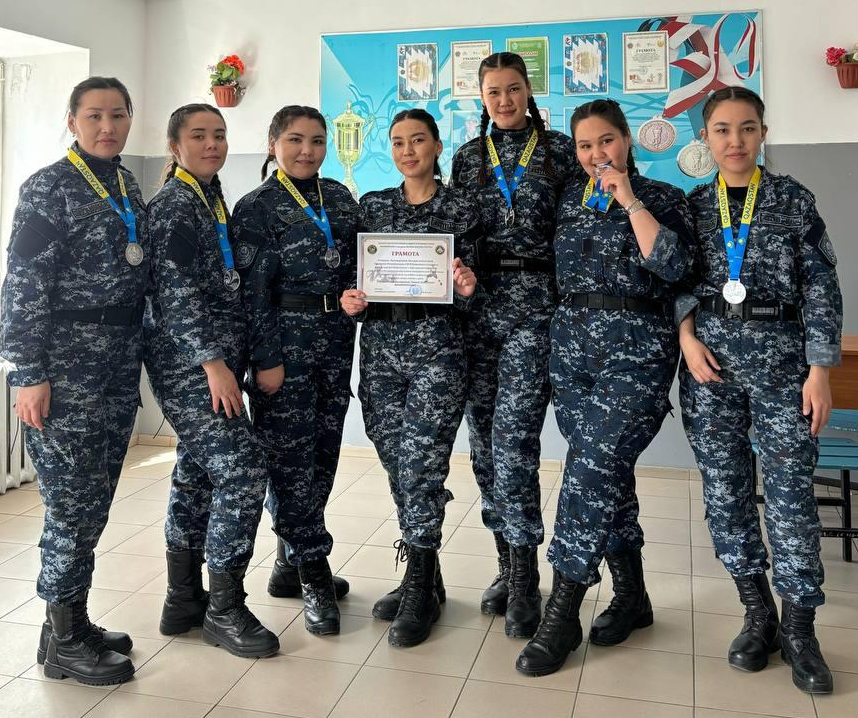
One might think this experience is enough to answer “yes” with confidence. And yet it was precisely this honest inner question that made me return to the FLIGBY simulation a second time—and go through it not as a student “playing a game,” but as a young researcher analyzing her own managerial behavior. This paper is not a review of entertainment. It is an attempt to combine personal leadership experience, the objective data from the simulation, and academic concepts of leadership, emotional intelligence, and flow into a single reflective analysis that could be useful to both early-career managers.
FLIGBY is the official leadership-development simulation, created based on Prof. Mihaly Csikszentmihalyi’s flow.
theory and maintained by the Leadership & Flow research network. The tool immerses the player in the role of a winery manager and, over the course of 150 story decisions, unobtrusively measures 29 managerial and leadership competencies, comparing them with an international database [1]. It is precisely this combination of a living story and objective measurement that makes the simulation a valuable means not only of learning but also of self-discovery.
How FLIGBY Entered My Learning Journey
My first encounter with FLIGBY happened during the second semester of my first year of the master’s program, in the course Value-Oriented Leadership, taught by my lecturer, Moldir Zhumabekovna Talpakova.
As part of our practical seminars, she introduced me to FLIGBY as a psychometric simulation for exploring and assessing leadership competencies. I did not simply receive the game as an assignment and play it on my own. I went through the simulation with her support. When I faced situations in which I was unsure how to proceed, she did not simply give me the answer. Instead, she asked questions, encouraged me to think, and gave me the small push I needed to make my own decision.
Looking back, I realize that this way of introducing me to FLIGBY was important for my experience.
I was not simply told what a “correct” leadership decision should look like; I was allowed to discover it myself.
Her support created a space in which I could make decisions, make mistakes, reflect on them, and gradually understand my own leadership behavior.
At that time, I did not yet realize how deeply this experience would influence the way I looked at leadership and at myself.

1. From game to learning: why the second playthrough changed everything
The first time, I honestly went through FLIGBY superficially. I got acquainted with the characters, followed the plot, and made decisions—but perceived what was happening a little “from the outside,” as an observer. Perhaps that is why some results of the first playthrough surprised and even stung me: they did not match the image of a leader I was used to seeing in myself.
I built the second playthrough in a fundamentally different way. Before making decisions, I opened the simulation’s built-in library, carefully read the accompanying materials, watched the recommended videos, listened closely to the hints, and tried to understand the meaning of every choice. And then FLIGBY stopped being a game for me. It became what it was designed to be: learning through solving real management problems—problem-based learning addressed to people who make decisions.
This difference is fundamental. Entertainment distracts; problem-based learning makes you think. The second time, every decision ceased to be a “move in a game” and became a management action whose consequences I could see. Here, it is worth recalling a simple idea: leadership is, above all, practice. One can know many theories and models, but until you test yourself in action, this knowledge remains potential. FLIGBY creates exactly that safe space for practice, which is so lacking in the training of future managers.
2. The virtual coach: not a prompt, but a different perspective
Only in the second playthrough did I truly grasp the role of the virtual coach. He does not make decisions for the player and does not divide choices into “right” and “wrong.” His task is to help you see the situation from a different angle. That is why the final decision always remains yours—and, together with the decision, the responsibility for it.
It seems to me that this is precisely where the tool’s pedagogical value lies: the combination of freedom of choice and professional feedback. The coach seems to add flavor like salt to a dish: he does not replace your decision but makes it meaningful. You are free to heed him or to act your own way, but you choose yourself, and you bear the consequences yourself. This model accurately reflects real managerial life, where a manager has advisers, data, and opinions, yet the right to, and the weight of, the final decision belongs to that person alone.
3. Why the simulation deserves to be taken seriously
In the second playthrough, I understood the main thing: the simulation must be taken seriously, and then it responds in kind. Its value lies precisely in the fact that it allows you to live through the consequences of your decisions genuinely, but without the real price of a mistake. In life, every word and every decision entails consequences that cannot always be undone. Here, the consequences are vivid—but safe.
On the one hand, the characters’ reactions feel almost real, and at times it even hurts a little—as it does in life, when you deal with real people. On the other hand, you understand that you are in a space where you can make mistakes and learn. The first time, I still had doubts: “It’s just a game.” The second time, these doubts were gone—because you find yourself in the leading role of your own film, and the distance between “game” and “life” disappears. That is exactly why I allowed myself to be truly inside the simulation.
4. Emotions as the driver of action: a theoretical frame
One of my own studies is devoted to the role of emotional intelligence in developing managerial competence, and in the second playthrough of FLIGBY, I saw especially clearly how theory works in practice. Daniel Goleman emphasizes that emotions are a natural mechanism that impels a person to act. The very word “emotion” comes from the Latin “emovere”—”to set in motion”: the root “moveo” means “to move, to set in motion,” while the prefix “e-“ indicates an outward direction. Thus, every emotion awakens an impulse to act; consequently, emotions do not oppose rational thinking but serve as a source of behavior and decision-making [2].
In managerial activity, this is especially important. A manager’s emotional state determines their actions, which directly affect the team’s work. A manager with high emotional intelligence uses their own emotions as a tool to achieve goals and can steer the team in the right direction. According to the model of J. Mayer and P. Salovey, emotional intelligence includes perceiving emotions, using them to facilitate thinking, understanding emotions, and managing them; R. Bar-On’s mixed model adds intrapersonal and interpersonal components, adaptation, and stress management [4; 5]. At the same time, according to Goleman’s estimates, about 67% of managerial effectiveness is linked precisely to emotional competence and only about 33% to technical skills and cognitive abilities [3]. Contemporary research confirms this: a 2024 study found a significant positive relationship between emotional intelligence and leadership competence in students [7], and a 2025 study showed that high emotional intelligence improves learners’ well-being and academic achievement [8].
This is exactly what I felt, especially clearly, in the second playthrough of FLIGBY. Although virtual characters surrounded me, the emotional feedback proved so alive that my decisions were perceived not as game moves but as managerial acts. After each choice, I felt its consequences in the team’s reaction—and it was precisely the emotions that made me reanalyze my own leadership behavior. From this, I conclude that the value of the simulation is that it allows you not merely to study emotional intelligence but also to apply it in specific management situations.
5. “Alex is me”: the moment that made me stop
The most powerful experience of the second playthrough was one short episode. In the first attempt, I had made different decisions in this situation—and one of the team members, Alex, had reacted differently then. The second time, when I acted differently and supported him, he suddenly said words that literally made me want to cry:
Yes, I am not perfect, but I am honest with myself. I work hard, but I keep running into resistance. I always honestly say what I think.

In that moment, I recognized myself in Alex. I caught myself thinking that I find it hard to admit my own mistakes, that I do not always see my own wrong traits—and when Alex said this out loud, I wanted to answer him: “Alex, I am the same.” It was an almost physical sense of recognition that no textbook can give.
Later, analyzing the episode as a researcher, I understood why it proved so piercing. Alex embodies assertiveness—the readiness to state one’s thoughts and needs honestly, without violating others’ rights. And self-awareness, according to Goleman, is the first and basic component of emotional intelligence: the ability to recognize one’s own emotions and to look at oneself honestly [2; 3]. The simulation gave me the rare chance to experience both states at once: to see assertiveness from the outside, in the image of another person, and in the same second to recognize it in myself. This is precisely the “mirror” for the sake of which it is worth going through FLIGBY seriously—a moment of honest self-reflection that in ordinary life is almost impossible to summon deliberately.
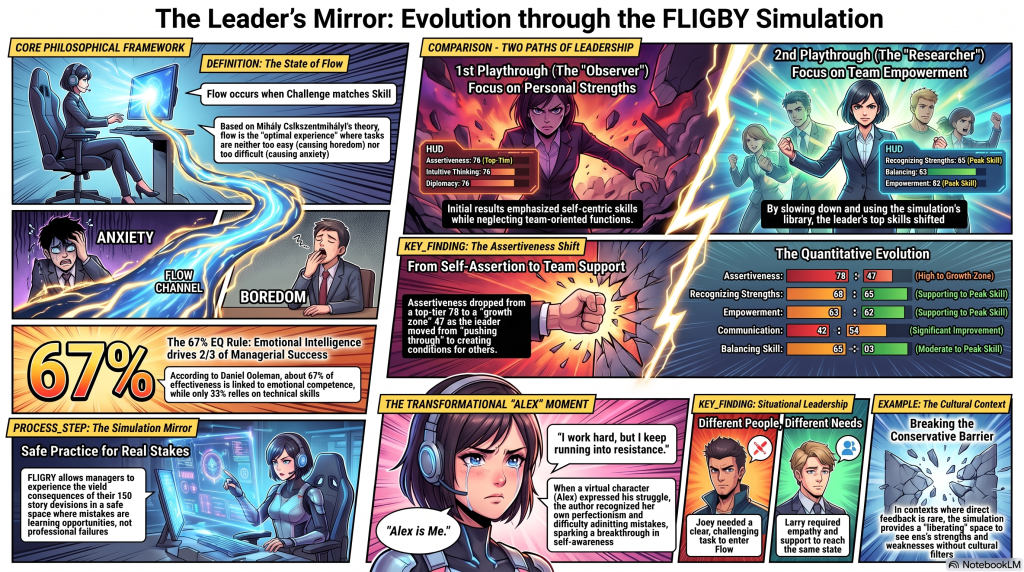
Tellingly, this episode was directly reflected in the numbers as well. It was precisely assertiveness—my strongest side in the first attempt—that moved into the growth zone in the second, because I consciously chose not to “push through” the situation but to support the person. Alex’s words became for me a living illustration of the fact that behind the dry scores lies a real choice between self-assertion and attention to the other.
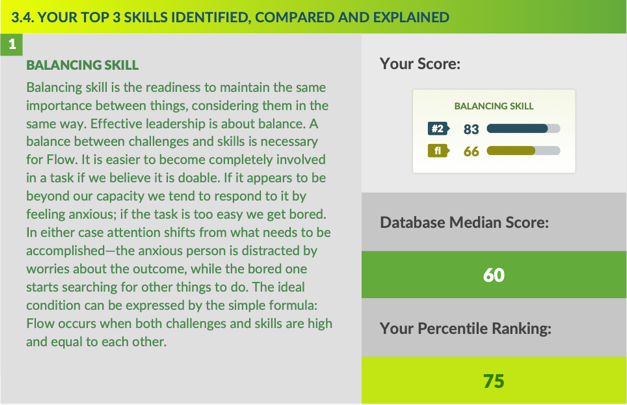
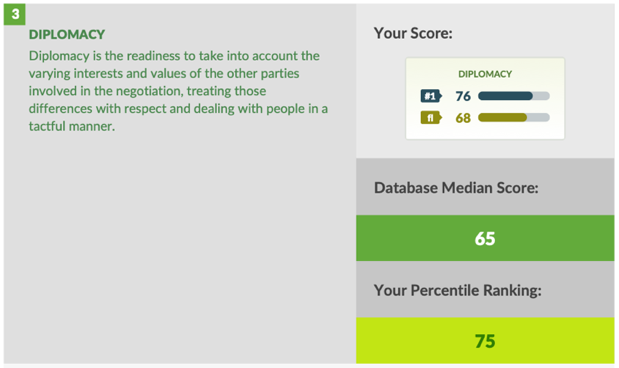
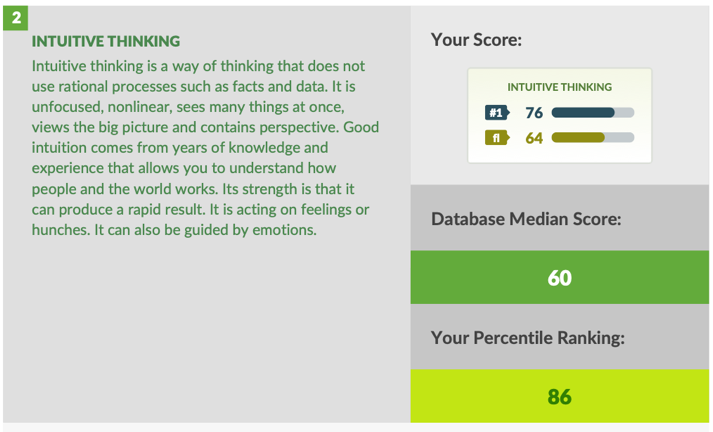
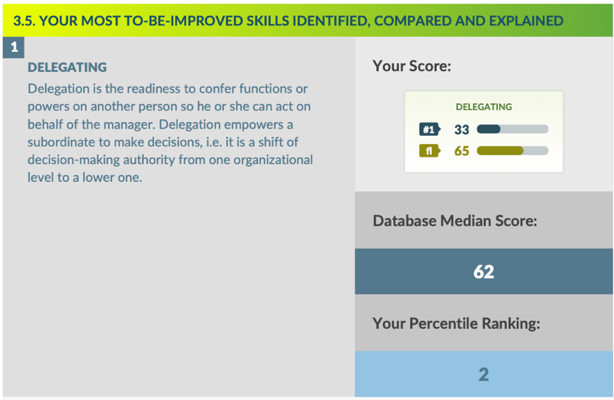
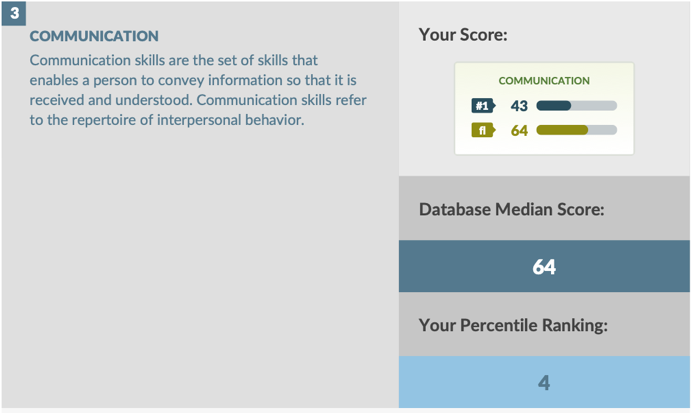
Individual results obtained after the first playthrough of the FLIGBY simulation.
6. The state of Flow: when challenge matches skills
FLIGBY is built on Mihály Csíkszentmihályi’s flow theory, and the second time I understood it not with my mind but through experience [6]. One of the game’s hints reads, “Don’t overthink every decision; trust your instinct and enjoy the process.” I am a person who grew up with “perfectionist syndrome,” and this idea turned out to be almost therapeutic for me: life itself is a journey, and one must learn to find joy in the process, not only in the final result.
Flow arises not when it is easy and not when it is impossible, but when the level of challenge matches the level of skill. If a task is too simple, boredom sets in; if it is beyond one’s capacity, anxiety sets in; and in both cases, attention drifts away from the task itself. From this follows the definition of leadership I arrived at: a leader is, above all, someone who creates conditions in which other people can reach a state of flow. At the same time, goals that are too easy lose their savor; what is truly valuable are goals that are difficult but attainable—those you reach in small steps and from whose attainment you feel genuine joy.
Adjacent to this is the idea of the human need for significance. Drawing on A. According to Maslow’s hierarchy of needs, once basic needs are met, it becomes vitally important for a person to feel needed and useful. The state of flow and the sense of one’s own worth seem to be built on this base: when a person comes to know himself and his work, a sense of satisfaction arises, and from it comes the inner stability that feeds flow. The leader’s task is to help every member of the team find personal meaning in the shared work, for it is meaning that turns work into a source of flow.
7. What the numbers showed: comparing the two playthroughs
The main value of FLIGBY lies not only in emotions and reflection but also in measurement. The simulation assesses 29 managerial and leadership competencies and compares the results with a database of around 25,000 participants worldwide and about 700 participants from Kazakhstan. This makes it possible to see not an abstract self-assessment but one’s position relative to thousands of other managers.
After the second playthrough, it was not merely individual figures that changed—the very configuration of my strengths changed. In the first attempt, my three peaks were “about myself”: assertiveness, intuitive thinking, and diplomacy, that is, the ability to state and defend one’s position. In the second attempt, competencies “about others” rose to the top: balancing, empowerment, and recognizing people’s strengths—skills that help the team rather than highlight the leader.
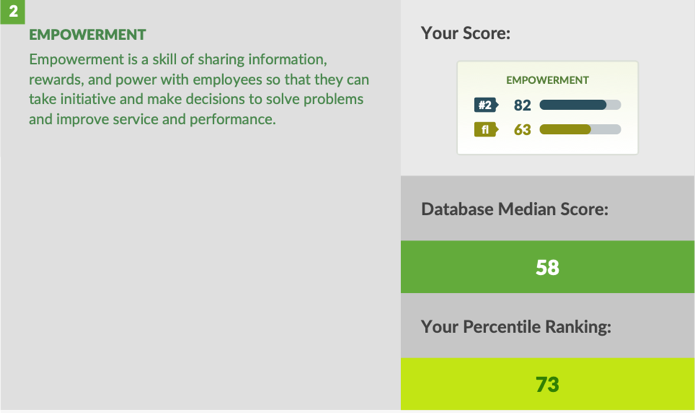
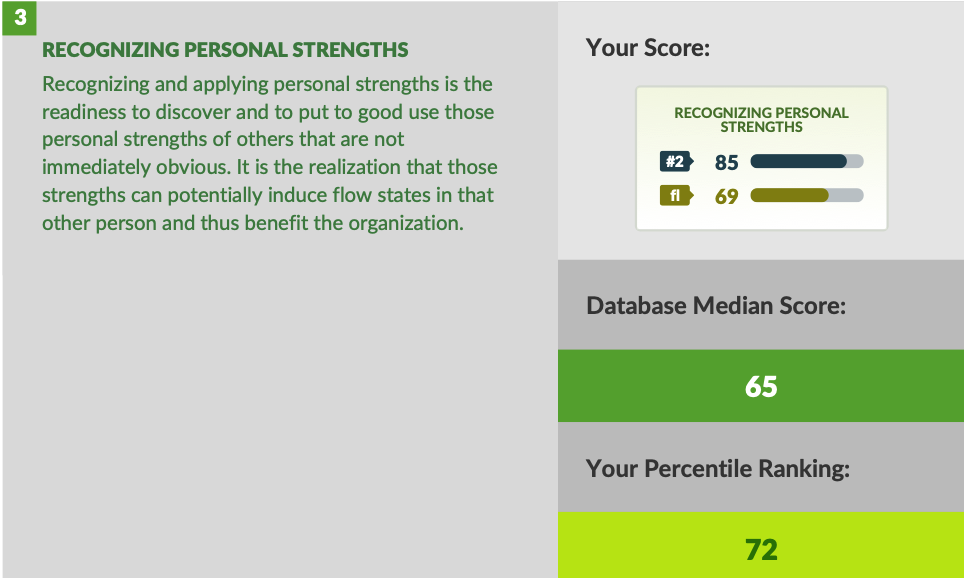
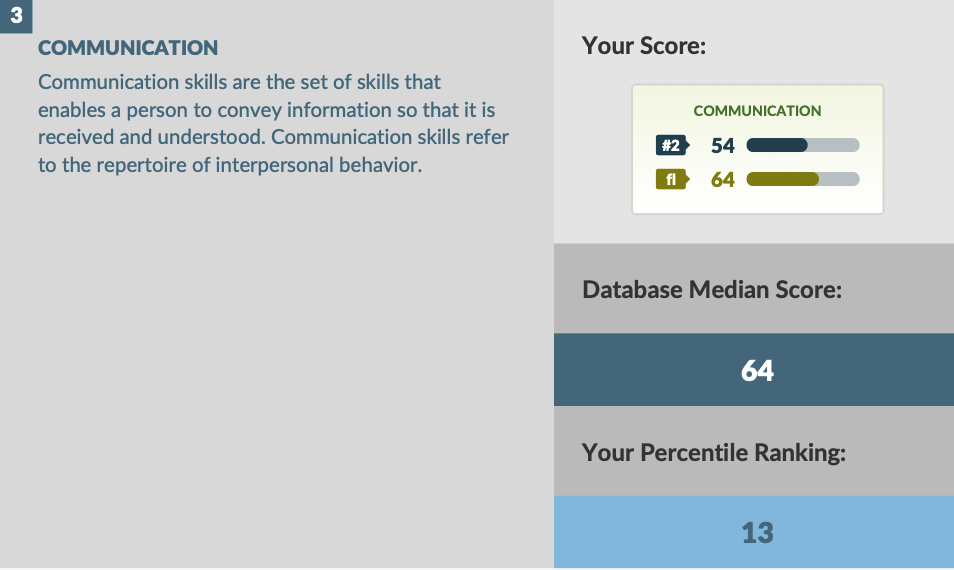
Individual results obtained after the second (repeat) playthrough of the FLIGBY simulation.
8. Why the profile changed: It’s about the understanding of context.
Between the attempts, it was not my leadership as such that changed, but my understanding of context. When I stopped “pushing through” the situation and began to create conditions for the team, assertiveness naturally gave way to skills that help others enter flow. This is neither a decline nor an improvement in the pure sense—it is a change of management strategy, and the simulation recorded it honestly.
The growth in communication is especially telling: my weak area on the first attempt (43 points) improved noticeably on the second (54 points)—and this happened precisely after I began to read the materials more attentively, listen to the coach, and immerse myself more deeply in the situations. In other words, a supportive, information-rich environment reinforced the development of a specific skill. This is exactly the conclusion I reach in my master’s work: Managerial competence is not formed by theory alone—it requires the practice of decision-making and an environment that supports this development. I understand competence as a set of personal qualities manifested in action, and a sense of competence, in turn, gives rise to confidence; it is precisely a confident leader whom people are inclined to trust.
9. Eight characters—eight parts of me?
A separate discovery was how I perceived the characters. I perceived the FLIGBY characters not as strangers but as eight parts of my own personality. Joey and Jen, for example, have weak time management—and I honestly recognized myself in them. All the qualities these characters possess are also in me—a little of each, in different combinations and proportions.
As a psychologist by first education, I am used to analyzing people’s behavior—not “reading” them, but making sense of them. And I am drawn to the idea that there are not infinitely many personality types: behind the outward diversity of people lie recurring combinations of traits, of which classical character typologies and theories of accentuation speak. People change less over the years than it seems to us: the degree to which one or another quality is expressed may increase or decrease, but its “root” remains. FLIGBY became a mirror in which these combinations of traits in me became visible and, importantly, measurable.
10. The situational nature of leadership: who needs support, who needs a challenge
Another conclusion the simulation literally “played out” together with me: a leader should not manage everyone in the same way. At a given moment, one person needs empathy and support; another needs a bar of expectations, responsibility, and even an ultimatum. When I set Joey a clear task, he coped and entered a state of flow. And in a difficult moment, Larry, on the contrary, was helped by support—and it was precisely support that opened his path to flow. The same managerial technique yields opposite results depending on the person and the situation.
This is situational leadership, which is so easy to read about in a textbook and so hard to feel until you find yourself facing a person’s living reaction. Here I also recall my own experience: working today as an inspector, in a subordinate position, I notice that in the absence of a supervisor, I sometimes lose my sense of control, while in the supervisor’s presence, I feel a note of stress. Yet it is precisely this note of stress that at times acts as a driver, mobilizing me. The leader’s task is to see who needs a challenge now and who needs support and not to confuse the one with the other.
Adjacent to this is the idea that innovations and the best decisions are born where different points of view come together. A team consists of very different people, but they are united by a common goal—to work in a comfortable, favorable, and productive environment. If a leader manages to bring these dissimilar people to a shared meaning and to a state of flow, they will move in one direction without losing their individuality. In this sense, leadership is also culture: every conversation, every decision, and every piece of feedback sends the team a message about how it is customary here to think, feel, and work, and over time, these small interactions precisely form the team’s culture.
11. Personal leadership experience and cultural context
I write this not from Spain and not from France, although European culture is indeed close to me, and the atmosphere of the winery in the plot gave me a sense of Italy and Spain. I am from Kazakhstan in Central Asia, and this context is important to understanding my view of leadership.
Three years of chairing the student council of a residence hall, where almost 480 young women with different characters, specialties, and dreams lived under one roof, taught me a simple but important thing: people are united not by sameness but by a common goal. We wanted to live our student years comfortably, harmoniously, and brightly—and where goals coincided, solutions were found; but where goals diverged or resources were lacking, conflicts arose that had to be resolved patiently. Later, while commanding a women’s platoon during initial training, I repeatedly found myself facing problems that had to be resolved here and now while being responsible for other people. And real life confirmed many times over: leadership is learned in difficulty, not in comfort.
At the same time, in our still largely conservative realities, many people still find it awkward to state their opinion openly. And in this respect, the value of the simulation is especially great: there are no such cultural barriers in it. You are in the leader’s position; people tell you to your face what they think of you—and you, honestly, without embarrassment, see the level of each of your qualities. For a young manager, especially one from an environment where it is not customary to discuss strengths and weaknesses directly, this is a rare and truly liberating opportunity to test oneself safely.

12. A critical view: how the tool could be developed further. As a researcher, I also see room for developing the simulation itself. The FLIGBY plot unfolds in the context of a winery—a vivid setting, though not the most common. It seems to me that the tool’s learning potential would grow if scenarios from other spheres were included: education, public administration, and social and pedagogical organizations. This would allow participants to try leadership decisions in a professionally familiar context and to transfer the experience gained into their own practice more accurately. I make this remark not as a complaint but as an acknowledgment of how rich and viable the approach itself appears to me.
And now my conclusions
First, FLIGBY ceases to be a game and becomes a tool for learning by solving real management problems as soon as the participant takes it seriously and consciously immerses himself in the materials and situations offered.
Second, emotions act as the driving force behind action; therefore, emotional intelligence directly affects the quality of managerial decisions. The simulation is valuable in that it allows one not only to study but also to apply emotional competence in a safe environment.
Third, a conscious change of behavioral strategy reshapes the leadership-competency profile: the shift from self-assertion to creating conditions for the team naturally changes the balance of strengths and weaknesses, as the comparison of the two playthroughs clearly confirmed.
Fourth, a supportive, information-rich environment accelerates the development of specific skills, and managerial competence is formed only in the unity of theory and the practice of decision-making.
Fifth, leadership is situational: one person needs support, another needs a challenge, and a manager’s maturity lies in the ability to distinguish these needs and to unite dissimilar people around a shared meaning.
Finally, the main personal takeaway is paradoxical. It is usually believed that experience makes a person confident. For me, almost the opposite happened: real life repeatedly showed that I cope as a leader, but it was precisely after FLIGBY that I first honestly asked myself whether I am truly confident in my leadership qualities. Experience gave me responsibility, and the simulation gave me a space for honest self-reflection that hardly ever exists in real work, where one pays a real price for a mistake. FLIGBY did not hand me a ready “yes” or “no.” It returned to me the right question—and the tools to work on the answer. And, perhaps, Alex’s words, in which I recognized myself, became the best confirmation that this space of honesty really works.
Next are my practical recommendations for future FLIGBY players:
1. Play seriously, as in real life. Do not treat the simulation as entertainment: value appears only when you make every decision as if real people stood behind it.
2. First, read the library, then make the decisions. Read the materials, watch the videos, and listen closely to the virtual coach. This is precisely where my entire difference between the first and second playthroughs arose.
3. Read the results as a mirror of you, and not as a verdict on you. A low score is not an assessment of your personality but a precise hint of what to work on. My access to the game remains open until October, and I plan to return to it and observe how my competencies change.
Acknowledgments and my further plans:
I am sincerely grateful to Moldir Zhumabekovna Talpakova for introducing me to FLIGBY and supporting my first experience with the simulation, as well as to Professor Zoltán Buzády and the Leadership & Flow Global Research Network team for developing this valuable learning tool.
I am sincerely grateful to Dr. Moldir Zhumabekovna Talpakova for introducing me to FLIGBY and for supporting my first experience with the simulation, as well as to Professor Zoltan Buzady and the Leadership & Flow Global Research Network team for developing this valuable learning tool.
In the coming months, I plan to go through the simulation several more times, purposefully developing communication, delegation, and time management, and to continue my study of the pedagogical conditions for developing managerial competencies in students as part of my master’s degree.
About the author:

Zhumadillayeva Togzhan Amirbekkyzy graduated with honors from the Kazakh National Women’s Pedagogical University (specialization “Psychology”). She is currently a 2nd-year master’s student at Sh. Ualikhanov Kokshetau University in the “Management and Leadership in Education” program. Her research topic is the psychological and pedagogical conditions for developing managerial competencies in students. She is the author of works on the gender characteristics of organizational leaders (using R. Cattell’s methodology, A. V. Karpov’s “Style of Managerial Decision-Making,” and A. N. Lutoshkin’s “I am a Leader”) and on the role of emotional intelligence in developing managerial competence. Practical management experience: chair of a residence-hall student council, commander of a training platoon, and inspector in the transport police department.
Zhumadillayeva Togzhan, Management & Leadership in Education graduate, Ualikhanov University, Kokshetau, Republic of Kazakhstan
References
- 1. Buzády Z. Flow, leadership and serious games — a pedagogical perspective // World Journal of Science, Technology and Sustainable Development. — 2017. — Vol. 14, Iss. 2/3. — P. 204–217. DOI: 10.1108/WJSTSD-05-2016-0035
- 2. Goleman, D. Emotional Intelligence. — New York: Bantam Books, 1995. — 352 p.
- 3. Goleman, D. Working with Emotional Intelligence. — New York: Bantam Books, 1998. — 383 p.
- 4. Mayer J. D., Salovey P. What is emotional intelligence? // Emotional Development and Emotional Intelligence: Educational Implications. — New York: Basic Books, 1997. — P. 3–31.
- 5. Bar-On R. The Emotional Quotient Inventory (EQ-i): Technical Manual. — Toronto: Multi-Health Systems, 1997. — 216 p.
- 6. Csikszentmihalyi M. Flow: The Psychology of Optimal Experience. — New York: Harper & Row, 1990. — 303 p.
- 7. López González J., Martínez J. M., Lomboy M., Expósito L. Study of emotional intelligence and leadership competencies in university students // Cogent Education. — 2024. — Vol. 11 (1).
- 8. Caballero-García P. Á., Sánchez Ruiz S. Emotional Intelligence and Its Relationship with Subjective Well-Being and Academic Achievement in University Students // Journal of Intelligence. — 2025. — Vol. 13 (4), 42.
Here is the full list of all our publications, with full text (!) for you: https://flowleadership.org/publications-on-leadership-development-and-management-skills/