By: Buzady Z., Almeida F.
In: Thinking Skills and Creativity (D1 cat. 93%), December 2026
Highlights
- •FLIGBY proves to be an effective experiential learning tool, fostering both thinking skills (e.g., emotional intelligence, leadership, systemic decision-making) and creative competencies, with strong interconnections between these dimensions.
- •The simulation environment promotes creativity through safe experimentation, adaptive decision-making, complex problem-solving, and metacognitive reflection, enabling students to transfer skills to real-world contexts.
- •Findings support serious games as a robust pedagogical strategy in higher education, enhancing student-centered, interactive learning while preparing students for complex and dynamic professional environments.
- •Policy implications highlight the need to integrate digital simulations into curricula, adopt performance-based assessment, and invest in teacher training to ensure effective pedagogical mediation and maximize learning outcomes.
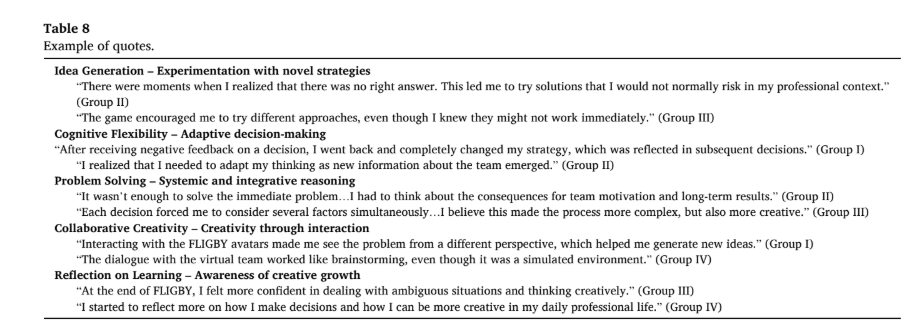
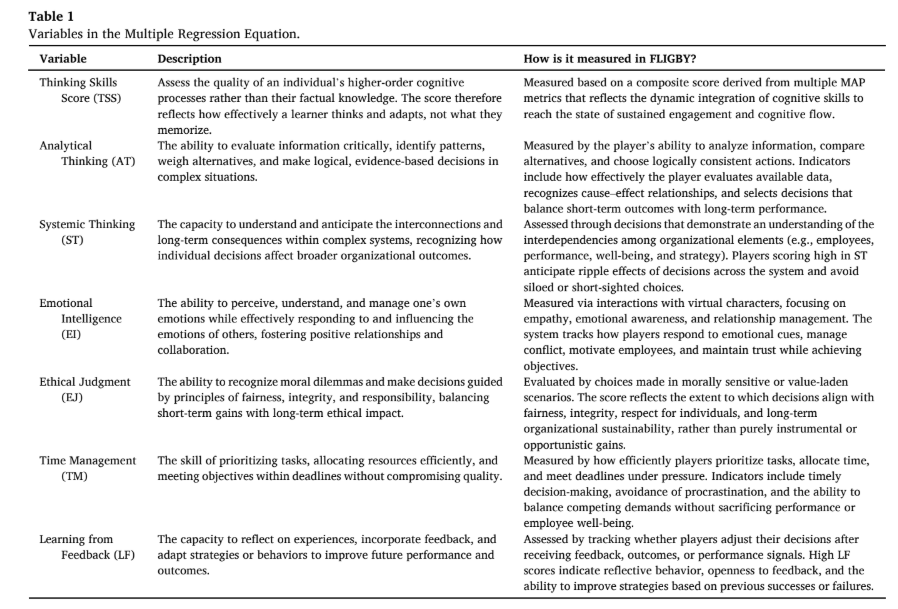
Abstract: This study addresses a gap in literature by empirically examining the role of FLIGBY in the development of thinking skills and creativity, contributing to a more holistic understanding of the pedagogical value of serious games in higher education. Two research questions guide the study: (i) how FLIGBY assesses and contributes to the development of thinking skills; and (ii) how the pedagogical approach and challenges embedded in FLIGBY foster creativity. A mixed-methods design was adopted. Quantitative methods were first used to assess students’ performance in thinking skills, which in FLIGBY are measured continuously through behavior-based analytics using the Master Analytics Profiler (MAP) system. In parallel, qualitative methods were employed to explore the development of creative competencies through thematic analysis of interview data. The results indicate that FLIGBY is an effective tool for the integrated development of thinking skills and creative competencies in higher education. Statistical analysis reveals moderate to high levels of cognitive skills such as emotional intelligence, leadership, and systemic decision-making, with strong and significant interrelationships among these dimensions. The thematic analysis further shows that FLIGBY fosters creativity by providing a safe environment for experimentation, adaptive decision-making, complex problem solving, and metacognitive reflection. Accordingly, the findings suggest that FLIGBY not only strengthens strategic cognitive skills but also stimulates creative and reflective processes transferable to real-world leadership and management contexts, offering important implications for educational practice and policy in higher education.