By: Lipovka A., Buzady Z., Abeshev K.
In: Problems and Perspectives in Management (Q2)
Full article here: http://dx.doi.org/10.21511/ppm.24(2).2026.38
Keywords: artificial intelligence (AI), business simulation, gender, hard skills, leadership competencies, managers, resource-based view theory, strategic planning
Abstract:
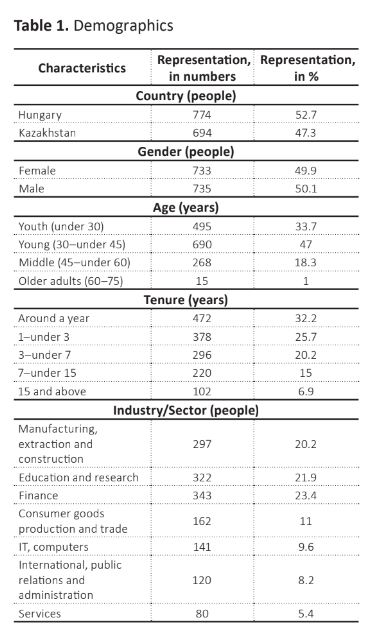
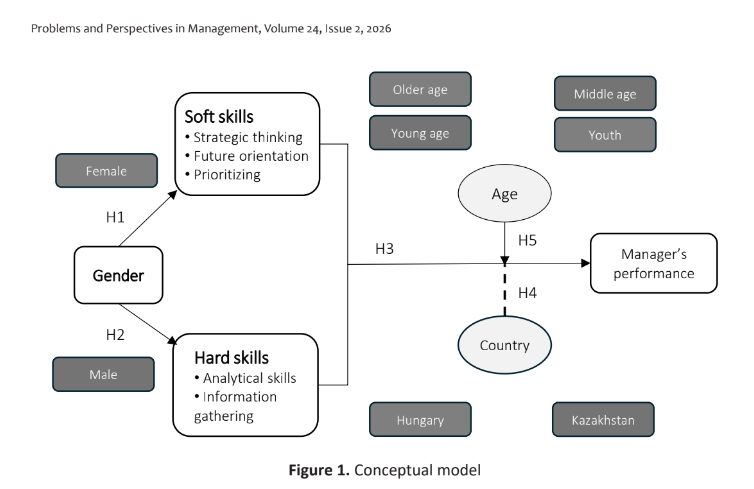
Strategic planning is a driver of leaders’ performance in today’s turbulent and demanding environment, yet the relative importance of soft versus hard skills within it remains insufficiently researched. This study aims to test how gender, age, and cultural context influence the distribution of soft and hard skills in strategic planning and managers’ goal attainment. Utilizing a behavioral outcome measure (high performance), we analyzed a sample of 1,468 managers from Kazakhstan (n = 694) and Hungary (n = 774), who participated in the scientifically grounded AI business simulation. A two-step analytical approach, involving PLS-SEM and logistic regression, was implemented in Python. The results demonstrate that soft skills are the dominant driver of high performance, with an Odds Ratio (OR) of 3.44, indicating they are 2.5 times more effective than hard skills. Leaders’ age exerted a negligible effect on their performance (OR = 1.02, p = 0.728). The overall sample showed no gender differences, but the country-specific analysis revealed a moderated mediation pattern where the link between gender and soft skills varies by country (p = 0.018). Managers in Kazakhstan exhibited slightly higher average softskill scores than their counterparts in Hungary (p = 0.014). Despite cultural differences, the model demonstrated consistent predictive utility in both settings, with an overall accuracy of 72.9% in Kazakhstan and 72.4% in Hungary. The designed competency model is highly stable and cross-culturally valid for predicting managerial performance. Thus, managerial excellence is driven by competencies that are largely independent of demographic characteristics across different cultural settings.