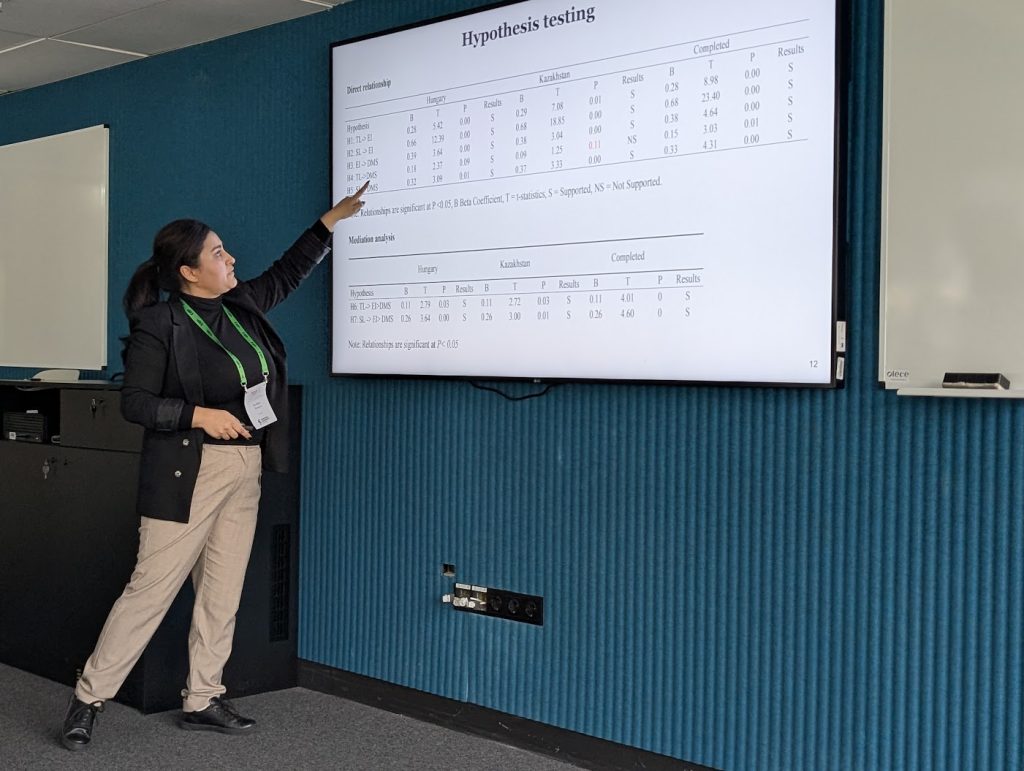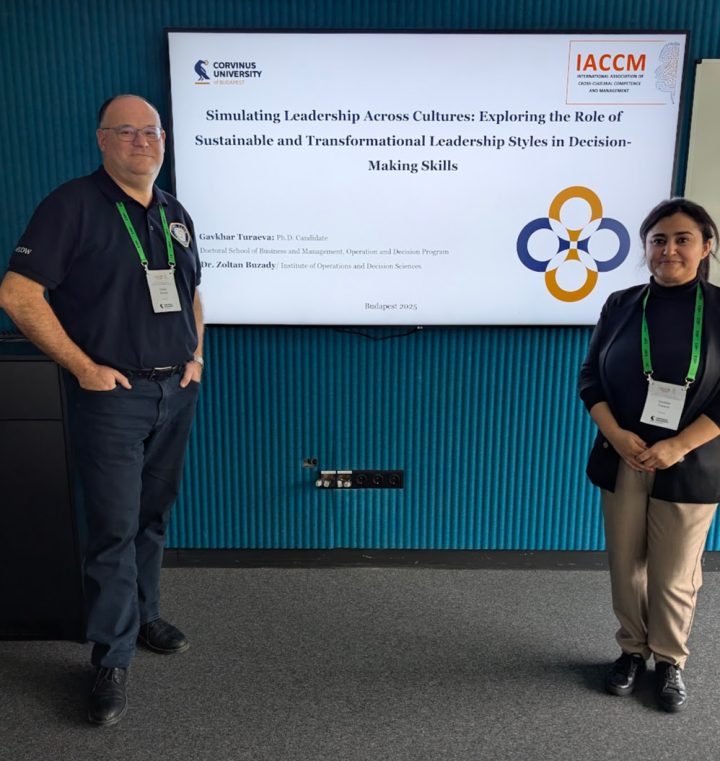
By: Gavkhar Turaeva and Zoltan Buzady, Corvinus University of Budapest
At the IACCM (International Association of Cross-Cultural Competence and Management) Conference
held October 29-31, 2025 at Corvinus University of Budapest
https://www.uni-corvinus.hu/post/landing-page/iaccm-2025/?lang=en
Full presentation here:
https://drive.google.com/file/d/1CmlwYwjW0I0fdFxbbd_iP72LWBHcAl2b/view?usp=sharing
Abstract : This research explores the impact of sustainable and transformational leadership styles on decision-making skills in cross-cultural, simulated management contexts. Sustainable leadership prioritises long-term vision, ethical considerations, and stakeholder accountability, while transformational leadership concentrates on inspiration, innovation, and performance enhancement. Despite the growing significance of both approaches in complex organisational settings, a few studies have examined the combined or individual impact of these approaches on leaders’ ability to make high-quality judgements in real-life situations. This study examines the disparity by investigating how leaders from diverse cultural backgrounds implement various leadership styles and how their methodologies affect decision-making efficacy and organisational results.
The research used FLIGBY (Flow Is Good Business for You), a serious game that simulates high-stakes leadership dilemmas. Participants play the position of virtual project manager and engage in a number of decisions related to team management, strategic compromises, and long-term planning. The simulation provides performance measurements in profitability, flow, and sustainability, allowing a detailed evaluation of how the leadership style influences decision-making and outcomes.
The data includes over 180 MBA students and early-career professionals from Hungary, and Kazakhstan, all holding at least one year of work experience and proficiency in English. Prior to the simulation, participants complete verified assessments evaluating their preference towards sustainable and transformational leadership. FLIGBY subsequently monitors their decisions and ensuing outcomes.
This study tests the following hypotheses to explore the results:
- H1: Sustainable leadership is positively associated with decision-making skills in FLIGBY.
- H2: Transformational leadership is positively associated with decision-making skills in FLIGBY.
- H3: Decision-making skills positively influence performance outcomes within the simulation.
- H4: Cultural background moderates the relationship between leadership styles and decision-making effectiveness.
This research discusses the functioning of two value-based leadership styles within a decision-making framework, providing insight into their potential harmony or independence. It shows how serious games, such as FLIGBY, may be used to evaluate and enhance leadership skills in a realistic, risk-free environment. The research provides a novel viewpoint on leadership effectiveness across cultures by emphasising decision-making as a primary result of leadership behaviour. It emphasises the need to incorporate ethical responsibility and motivating impact in the preparation of future leaders for more global and intricate organisational environments.
Extended Abstract:
1. Introduction
2. Literature Review
2.1 Transformational Leadership Transformational leadership is defined by the ability to inspire and elevate followers through vision, intellectual stimulation, and individualized consideration (Bass & Avolio, 1994). Research shows that transformational leaders are more likely to be adaptive in uncertain environments and capable of fostering resilience in their teams (Northouse, 2021).
2.2 Sustainable Leadership Sustainable leadership integrates ethics, social responsibility, and a long-term orientation. It involves leadership practices that balance short-term performance with enduring organizational health (Hargreaves & Fink, 2006). Sustainable leaders act as stewards, prioritizing well-being, ecological balance, and ethical decision-making.
2.3 Flow-Promoting Leadership Rooted in Csikszentmihalyi’s (1990) Flow Theory, flow-promoting leadership emphasizes the creation of conditions where individuals are deeply engaged, challenged appropriately, and intrinsically motivated. Leaders who foster flow enable higher creativity, innovation, and resilience in teams.
2.5 Serious Games in Leadership Development Serious games like FLIGBY offer immersive environments to assess leadership competencies in real-time. FLIGBY, based on Flow Theory, simulates complex management scenarios, tracking player decisions related to motivation, conflict resolution, stakeholder engagement, and long-term thinking (Mulvihill, 2019). It enables observation of authentic leadership behavior across cultural and contextual variables.
3. Research Questions
1. How do transformational, sustainable, and flow-promoting leadership styles influence emotional intelligence among participants from Hungary, Turkey, and Kazakhstan?
2. What is the relationship between these leadership styles and the participants’ decision-making skills in the FLIGBY simulation?
3. To what extent does emotional intelligence contribute to effective decision-making in simulated management scenarios?
4. How do emotional intelligence and decision-making skills together affect organizational performance outcomes (Flow, Profit, and Sustainability) in a serious game environment?
4. Hypothesis
H1: Leadership styles (transformational, sustainable, flow-promoting) positively influence emotional intelligence.
H2: Leadership styles positively influence decision-making skills.
H3: Emotional intelligence positively affects decision-making skills.
H4: Emotional intelligence and decision-making skills positively influence organizational performance (Flow, Profit and Sustainability)
5. Methodology
5.1 Research Design The study adopts a quantitative, cross-sectional comparative design. Structural Equation Modeling (SEM) via SmartPLS will be used to examine the relationships between leadership style constructs and performance outcomes, with cultural background as a moderating variable.
5.2 Participants Participants will include approximately 180 MBA students and early-career professionals from Hungary, Turkey, and Kazakhstan (approximately 60 from each country). Participants will be recruited from business schools and corporate leadership development programs. Eligibility requires at least one year of work experience and fluency in English.
5.3 Procedure: Participants will individually complete the FLIGBY simulation under standardized conditions. The game captures a range of leadership decisions and generates detailed performance metrics. Prior to the game, participants will complete a survey measuring leadership tendencies and cultural orientation.
5.5 Data Analysis Data will be analyzed using SmartPLS 4. The SEM approach will involve:
- Measurement Model Assessment: Reliability (Cronbach’s alpha, composite reliability), convergent validity (AVE), and discriminant validity (HTMT).
- Structural Model Testing: Examining the influence of leadership styles on FLIGBY performance metrics.
- Multi-Group Analysis (MGA): Conducted to compare path coefficients across the three national groups.
- Descriptive and Inferential Statistics: ANOVA and t-tests will supplement SEM results to examine country-level differences in leadership performance.
6. Expected Results and Contributions 7. Practical Implications
8. Conclusion
Leadership resilience and adaptability are increasingly vital for navigating today’s turbulent business landscape. This study contributes to both theory and practice by examining transformational, sustainable, and flow-promoting leadership styles through the lens of a serious game, across three culturally distinct contexts. It underscores the role of experiential learning and cross-cultural awareness in preparing leaders for the complex challenges of the 21st century.
Keywords:
Cross-cultural, Sustainable Leadership, Leadership Style, Transformational Leadership, Hungary, Kazakhstan, MBA, EMBA Decision-making Skills, Skills