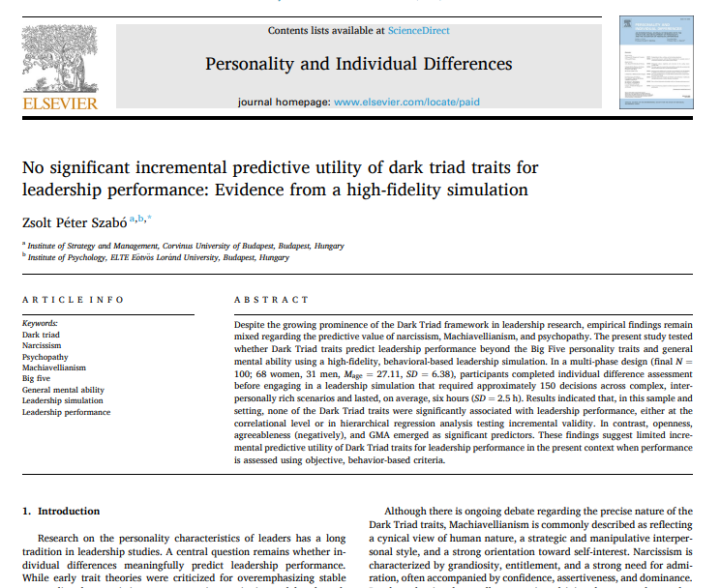
by: Zsolt Péter Szabó, Associate Professor at Corvinus University of Budapest and ELTE
in: Personality and Individual Differences (Q1 Journal)
Full article HERE
Highlights
- •DT did not predict leadership performance in a high-fidelity simulation
- •Leadership was assessed using a behavior-based simulation
- •DT showed no incremental validity beyond Big Five and general mental ability
- •Openness, agreeableness, and general mental ability predicted performance
Abstract
Despite the growing prominence of the Dark Triad framework in leadership research, empirical findings remain mixed regarding the predictive value of narcissism, Machiavellianism, and psychopathy. The present study tested whether Dark Triad traits predict leadership performance beyond the Big Five personality traits and general mental ability using a high-fidelity, behavioral-based leadership simulation. In a multi-phase design (final N = 100; 68 women, 31 men, Mage = 27.11, SD = 6.38), participants completed individual difference assessment before engaging in a leadership simulation that required approximately 150 decisions across complex, interpersonally rich scenarios and lasted, on average, six hours (SD = 2.5 h). Results indicated that, in this sample and setting, none of the Dark Triad traits were significantly associated with leadership performance, either at the correlational level or in hierarchical regression analysis testing incremental validity. In contrast, openness, agreeableness (negatively), and GMA emerged as significant predictors. These findings suggest limited incremental predictive utility of Dark Triad traits for leadership performance in the present context when performance is assessed using objective, behavior-based criteria.
Keywords
Dark triad Narcissism Psychopathy Machiavellianism Big five General mental ability Leadership simulation Leadership performance
Leadership performance in FLIGBY was assessed using the Leadership Performance Score (LPS). Although the simulation generates multiple outcome indicators, the present study focused on the LPS because this provides the most standardised and behaviourally integrated summary of leadership-related decision quality within the simulation. The LPS reflects the proportion of expert-endorsed decisions made across 79 key dilemmas embedded in the simulation.
from Article
All our earlier publications HERE